
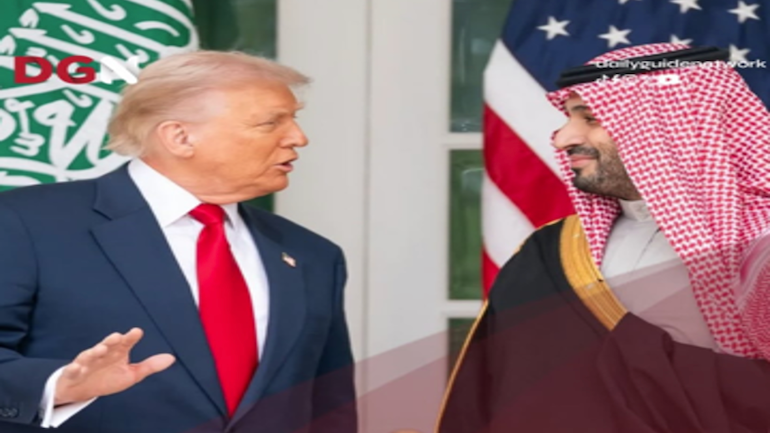
After decades of contentious discussions, US President Donald Trump has approved a nuclear agreement with Saudi Arabia that could enable the kingdom to enrich uranium. US Secretary of Energy Chris Wright and Saudi Minister of Energy Prince Abdulaziz bin Salman signed the peaceful nuclear cooperation agreement, known as a 123 agreement, alongside an accompanying bilateral safeguards agreement.
Under Section 123 of the 1954 US Atomic Energy Act (AEA) the US may engage in significant civil nuclear cooperation with other nations provided nine non-proliferation criteria are met. These are designed to prevent US technology from being used to develop nuclear arms or to transfer sensitive nuclear materials to others and normally include foregoing enrichment and reprocessing capabilities. Saudi Arabia has hitherto refused to sign a 123 Agreement because of these restrictions.
However, Section 123 of the AEA does not forbid a foreign nation from enriching uranium but mandates that the US retains “consent rights” over any enrichment or reprocessing that uses US-supplied materials, equipment, or technology. Previously, any country signing a 123 agreement with the US, such as UAE or South Korea, has been obliged to accept the “gold standard” of no enrichment. However, this is a policy choice – a strict diplomatic preference adopted by previous administrations, not a statutory requirement written into Section 123.
The law only requires that a partner nation cannot enrich or reprocess US-origin material without explicit US consent. President Trump granted Washington’s upfront, legal “consent” for Saudi Arabia to enrich uranium, satisfying the literal text of the AEA.
The Saudi deal also omits the enhanced “Additional Protocol” safeguards managed by the International Atomic Energy Agency (IAEA), which allow for unannounced snap inspections. Instead, oversight functions through a bilateral framework negotiated directly between Washington and Riyadh.
The text of the agreement dictates that American firms will only build an enrichment plant after a joint US-Saudi economic and technical feasibility review formally justifies it. To maintain non-proliferation control without using the IAEA’s Additional Protocol, the facility is expected to use a “blackbox” framework whereby a US consortium will own, secure, and physically manage the centrifuge technology inside Saudi borders.
The US Department of Energy (DOE) said: “The 123 agreement provides great access for American companies in the Saudi nuclear energy program, benefiting American industry, workers, and supply chains while helping to meet Saudi energy needs. “
DOE added that the agreement “builds on President Trump’s Executive Order 14299, Deploying Advanced Nuclear Reactor Technologies for National Security, and specifically Section 8 on Promoting American Nuclear Exports, which supports an expansion of international partners for US civil nuclear cooperation under Section 123 of the Atomic Energy Act of 1954, as amended.
This partnership will:
- Expand American nuclear technology exports;
- Create high-paying US jobs and long-term economic growth;
- Strengthen America’s energy and national security posture;
- Reinforce global non-proliferation standards; and
- Deepen the strategic partnership between the US and Saudi Arabia.
The agreement will now be transmitted to Congress for review. Congress has a mandatory 90-legislative-day review period. For lawmakers to block the Saudi civil nuclear programme from taking effect, both chambers must pass a joint resolution of disapproval with a two-thirds majority to override a guaranteed presidential veto. Bipartisan pushback is expected due to the lack of traditional international inspection guardrails.
The agreement is the culmination of nearly two decades of complex, stop-and-start geopolitical negotiations with Riyadh’s insistence on domestic uranium enrichment and the US demand for strict non-proliferation controls.
Saudi Arabia wants to benefit from the entire nuclear value chain, not just to generate nuclear energy, Minister of State for Foreign Affairs and Climate Envoy Adel Al-Jubeir said during the 2024 World Economic Forum in Davos. “We want to have a nuclear programme in Saudi Arabia to produce energy, we have between 1% and 4%, according to estimates, of the world’s uranium deposits in country, it makes a lot of sense to exploit those resources economically by mining it – it makes even more sense that once you mine it, that you engage in the processing to turn the uranium into fuel that you can sell at a higher price,” he said.
In 2008, the George W Bush administration signed a non-binding memorandum of understanding (MOU) with Riyadh. Saudi Arabia initially stated its intent to buy nuclear fuel from international markets rather than enriching it domestically. In 2009 the UAE signed a “Gold Standard” 123 Agreement renouncing domestic enrichment and reprocessing and Washington demanded that any future Saudi deal should follow suit, which Riyadh consistently rejected.
Between 2012 and 2019 during the Obama administration and Trump first term both administrations attempted in vain to secure a deal. During Donald Trump’s first term, DOE approved limited “Part 810” authorisations for American firms (like Westinghouse) to share preliminary technical data with Riyadh. However, negotiations stalled over inspection protocols.
The Biden Administration (2021–2024) shifted strategy offering a US civil nuclear package and a mutual defence treaty on condition Saudi Arabia normalised diplomatic relations with Israel. While Riyadh welcomed the defence and nuclear components, the normalisation talks fractured over the Gaza war and Saudi demands for a clear pathway to a Palestinian state. Riyadh simultaneously floated the threat of partnering with China or Russia to build its reactors.
Returning to office, Trump signed Executive Order 14299 to aggressively fast-track US nuclear exports and shut out foreign competitors. During a White House meeting in October 2025, Crown Prince Mohammed bin Salman and US negotiators quietly concluded the technical draft text. Trump dropped the Biden-era Israel normalisation prerequisite to close the deal. After lingering as an unsigned draft for months due to concerns over bipartisan pushback, the White House issued a national security waiver.
This allowed DOE to sign the bilateral framework allowing Saudi enrichment under US-contracted “blackbox” oversight. The aim is to lock Saudi Arabia into a 30-year civilian partnership, fundamentally binding Riyadh to US energy infrastructure and excluding China and Russia.
The overall US-Saudi civilian nuclear agreement is projected to be worth tens of billions of dollars over its 30-year lifespan. While the size of Westinghouse’s specific cut has not been formalised in an active contract, the market implications are substantial. Saudi Arabia wants to build at least two large-scale reactors immediately. If Westinghouse wins the final engineering, procurement, and construction (EPC) contract for its AP1000 reactors, the initial build phase alone is valued at $15-20bn.
Because the 123 Agreement seeks to lock Saudi Arabia into the US supply chain for 30 years, Westinghouse stands to secure a highly lucrative monopoly on fabricating and servicing the fuel assemblies required for those reactors over three decades. Westinghouse does not possess commercial uranium enrichment facilities. If Saudi Arabia builds a domestic enrichment plant, Westinghouse would build and manage the facility, but not provide the technology. Most likely Centrus Energy or a broader US-led consortium would supply the centrifuge hardware, while Westinghouse would convert that output into usable reactor fuel.
However, it remains to be seen, first whether Congress approves the deal, and secondly whether Saudi Arabia will agree to exclusively opt for American technology. As a result of an earlier tender, it has already received offers from South Korea, France, Russia and China to build the two planned reactors. Almost certainly most of these would be more attractive economically than Westinghouse.


