
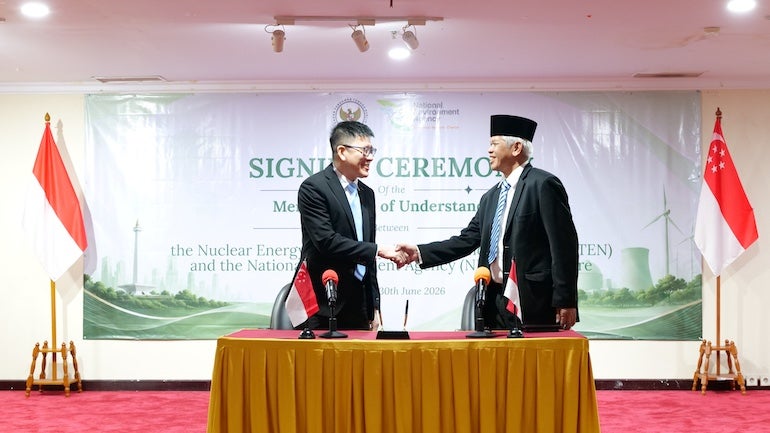
The National Environment Agency (NEA) of Singapore and the Nuclear Energy Regulatory Agency of Indonesia (Bapeten) have signed a memorandum of understanding (MOU) to cooperate on radiation protection, nuclear safety, security and safeguards. The MOU was signed in Jakarta by NEA CEO Dr Benjamin Koh, and Ir. Zainal Arifin, Acting Chairman of Bapeten.
NEA is Singapore’s national authority for radiation protection and nuclear safety and is building capabilities to support the Government’s study of deployment of nuclear energy. Bapeten is the national authority responsible for regulating nuclear energy use in Indonesia, including ensuring safety, security and safeguards for nuclear and radiation facilities.
NEA and Bapeten will collaborate in a range of areas, including nuclear regulatory policy, regulation of radiation and nuclear applications, radiological and nuclear emergency preparedness and response, as well as environmental radiation monitoring. This will involve joint training, personnel exchanges, research partnerships, and technical meetings.
The agreement builds on the longstanding bilateral cooperation between the two regulatory agencies, as well as information-sharing and coordination through Association of Southeast Asian Nations (ASEAN) platforms, including the ASEAN Network of Regulatory Bodies on Atomic Energy (ASEANTOM). These initiatives strengthen regional practices and standards on radiation protection, nuclear safety, security, and safeguards, emergency preparedness and response and regulatory capabilities.
“This collaboration builds on our longstanding bilateral partnership to strengthen cooperation in nuclear safety, regulatory oversight and emergency preparedness, as Singapore studies the potential role of nuclear energy in its future energy mix,” said Dr Koh. “It also reflects NEA’s commitment to working with ASEAN partners to strengthen regional cooperation, build trust, and enhance collective preparedness for radiological emergencies.”
Zainal Arifin said, Bapeten views the co-operation not only as a technical exchange, but as a long-term strategic partnership that contributes to regional safety and security architecture. “We believe that this partnership has significant potential to be elevated into a more strategic and impactful collaboration, particularly in strengthening regulatory capacity, enhancing safety and security oversight, and addressing emerging challenges in nuclear and radiation applications.”
Singapore is evaluating its ability to potentially deploy nuclear using the International Atomic Energy Agency (IAEA) Milestones Approach which is a phased comprehensive method to assist countries that are considering or planning their first nuclear power plant. It assesses 19 areas, such as managing nuclear safety, radioactive waste, and emergency planning.
Singapore will host a phase 1 IAEA Integrated Nuclear Infrastructure Review (INIR) mission in 2027 following the completion of a self-evaluation report.
However, Prime Minister Lawrence Wong has emphasised that the decision to adopt and deploy nuclear energy has not been made yet. The phase 1 review is to assess whether Singapore is ready to make an informed decision on nuclear energy deployment. The decision to deploy nuclear power will heavily depend on safety, which will always be the “overriding priority”, he noted.


