
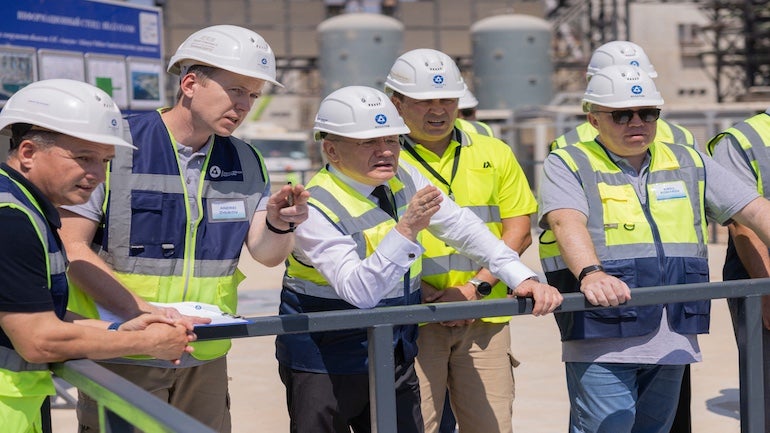
A Rosatom delegation led by Director General Alexey Likhachev, has visited the Akkuyu NPP under construction in Türkiye to assess the progress of commissioning work at unit 1 where construction work has officially been completed. The project has officially shifted from the civil construction phase to full-scale pre-commissioning and start-up operations. Cold hydrostatic tests of the reactor plant safely began immediately following the delegation’s inspection. The cold testing phase is scheduled for completion over the next few weeks. Success in cold tests will directly enable hot run-in procedures to verify equipment reliability.
Likhachev visited the central hall of the reactor compartment, where he was informed about the successful completion of operations to load simulated fuel assemblies into the reactor, as well as completion of reactor assembly. After loading the simulation core, specialists installed the block of protective pipes and the upper block of the reactor, completing one of the most important stages of preparing the reactor for the tests.
“There will be literally a few weeks left before the start of launch operations, and based on the results of all the work done, an audit will be carried out and adjustments will be made at the final stage,” Likhachev said. “This inspiring moment is akin to finishing the last 100 metres in a 42-kilometre marathon race. This is the very last push, when all efforts must be mobilised and a key part of this the work of service personnel. The number of personnel at unit 1 is 1930, and more than 40% of these specialists are Turkish citizens. We are proud that these are graduates of our universities who are undergoing training and practice at Russian simulators and nuclear power plants.”
The plant will eventually host four Russian-designed VVER-1200 reactors. The pouring of first concrete for unit 1 took place in April 2018, for unit 2 in June 2020, for unit 3 in March 2021, and for unit 4 in July 2022. Rosatom is constructing the reactors according to a build-own-operate model. Work continues at the facilities of all four units and auxiliary structures as well as a new town for plant operators. Unit 1 is scheduled for launch later this year.
Likhachev subsequently told Interfax: “Any other vendor would have abandoned the Akkuyu project two years ago. They would have found a number of reasons – legal, justified ones, and would have argued their case in court because the project was impossible to implement for various reasons. Nevertheless, we have begun start-up operations at the first unit.”
Implementation of the project has faced a number of problems, including non-delivery of equipment and sanctions. The non-delivery of critical equipment by Siemens Energy nearly halted the project, prompting Rosatom to source alternative components to bypass Western sanctions. Siemens Energy was contracted to supply gas-insulated switchgear equipment, which is vital for power distribution and connecting the nuclear plant to the Turkish national grid.
The equipment was fully manufactured and pre-paid. However, Siemens Energy withheld the items in its warehouse citing a lack of German government export and customs clearances in the wake of the conflict in Ukraine. Likhachev announced that Rosatom is launching a formal lawsuit against Siemens to recoup the financial losses and extra costs resulting from the breach of contract.
To avoid catastrophic timeline delays, Rosatom abandoned the Siemens order. They transferred the contract to a Chinese manufacturer, which rapidly produced, delivered, and installed the replacement equipment. Turkish President Recep Tayyip Erdogan personally intervened. He raised the issue directly with then German Chancellor Olaf Scholz, heavily criticising the retroactive application of export restrictions.
Beyond hardware, the project suffered as a result of $2bn in frozen investments and heavy disruptions to international payment systems due to sanctions. Likhachev credited extraordinary financial interventions by the Russian government and Central Bank for keeping Turkish contractors paid and construction moving avoiding a total shutdown.


