
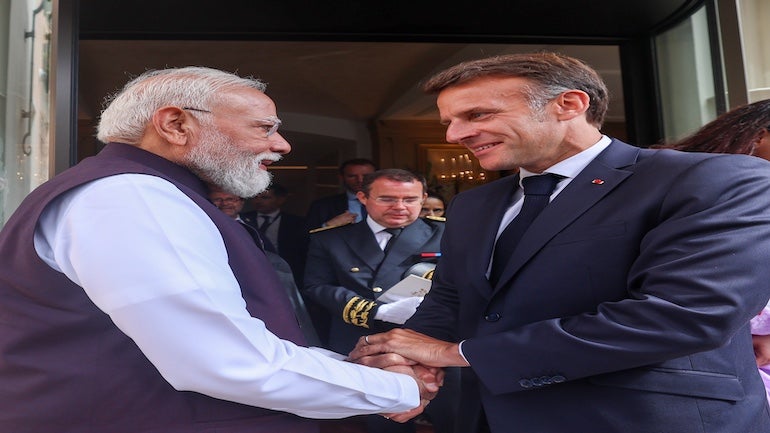
During Indian Prime Minister Narendra Modi’s official visit to France in the run-up to the G7 meeting, discussion with French President Emmanuel Macron included civil nuclear energy co-operation. This was the first meeting between the two leaders since bilateral ties were elevated to a special global strategic partnership during Macron’s visit to India in February.
During the visit, India and France signed 13 major agreements and initiatives covering technology, trade, defence and space. Civil nuclear cooperation is expected to increase in the wake of India’s passage of the Sustainable Harnessing and Advancement of Nuclear Energy for Transforming India (SHANTI) Act that fundamentally reformed the sector. The 2025 SHANTI Act replaced the 1962 Atomic Energy Act, and 2010 Civil Liability for Nuclear Damage Act and enabled limited private participation in the nuclear sector. Modi and Macron noted that the Act creates “new opportunities” for collaboration, including on small and advanced modular reactors.
Foreign Secretary Vikram Misri, during a special briefing by the Ministry of External Affairs, invited French nuclear companies for direct participation in the Indian nuclear sector, under the SHANTI Act. “I think the field is open for French nuclear companies, in this case, to start looking at direct participation in the Indian nuclear sector or do so in participation with Indian private sector companies, whether in conventional nuclear power reactors or in the more advanced small modular reactors.”
He said Modi shared his vision on this with Macron, who “welcomed the outlook that was provided, and both sides agreed to encourage their respective agencies to remain in touch on these issues”. He added: “But in parallel, there is a rich vein of discussions that has been opened on the aspect of small modular reactors and advanced modular reactors. And there too, there has already been a considerable amount of discussion between the two sides.” He noted that a strategic task force between the two countries was looking at this.
He confirmed that Modi and Macron had discussed nuclear cooperation in view of the changes in India’s nuclear industry “by permitting not just private sector participation in the nuclear sector, but also foreign direct investment in the nuclear sector”.
He noted: “The field is open for French nuclear companies…to start looking at direct participation in the Indian nuclear sector or…in participation with Indian private sector companies, whether in conventional nuclear power reactors or in the more advanced SMRs.”
Misri pointed to past discussions between France’s state-run EDF Group and the Nuclear Power Corporation of India Limited (NPCIL) on a nuclear power project at Jaitapur in Maharashtra, and said Modi highlighted the changes introduced to the nuclear industry by the SHANTI Act to facilitate private sector participation and foreign direct investments.
He said the discussion had primarily been carried on between EDF and NPCIL “on both the technical aspects of this project, as well as the very important financial aspects of the project”. He added: “These discussions are carrying on. They are taking into account, I think, the fairly dynamic scenario of nuclear technology itself, the innovations that have been made, and also the different possibilities that are there insofar as financing is concerned.” he said.
While confirming that negotiations remain active and ongoing, he explained that, rather than signing a final commercial contract, the discussions focused on restructuring the long-delayed project to resolve lingering financial and engineering barriers.
The Jaitapur Nuclear Power Project (JNPP) is a planned 10,380 MWe mega-project located in the coastal Madban village of the Ratnagiri district in Maharashtra. First agreed by the Indian government in October 2005, it is designed to become the world’s largest nuclear power station by net generating capacity.
However, the project has been stalled in complex negotiations and local gridlocks for over two decades. Following the easing of international civil nuclear sanctions against India, the site was officially cleared for imported Light Water Reactors. In 2010 India and France signed a foundational $9.3bn pact to build the first two reactors. The deal was signed by NPCIL and the French nuclear company Areva. Following Areva’s financial restructuring and bankruptcy, EDF took over the project leadership in 2016.
In 2021, EDF submitted a comprehensive techno-commercial offer to NPCIL to supply engineering studies and equipment for six third-generation Evolutionary Power Reactors (EPRs). The project’s multi-decade delay is the result of several factors. India’s legacy civil nuclear liability laws held foreign equipment suppliers financially legally responsible for any industrial accidents. EDF and the French government refused to sign a final commercial contract under these parameters, creating stalemate that was only recently unblocked by the SHANTI Act.
The project has also faced fierce resistance from local activist networks, local farmers, and fishing communities. The plant impacts over 900 hectares of land, threatening the local cultivation of export-quality Ratnagiri Alphonso mangoes and regional cashew farming. Local fishermen fiercely oppose the plant’s design, fearing that hot water discharged back into the Arabian Sea will devastate the lucrative regional prawn and fish populations. Activists frequently raise concerns that the coastal site sits in a designated Seismic Zone III area.
Historically, critics and economists have questioned the financial wisdom of the plant. Early EPR projects built by France in Finland and France suffered severe cost overruns and decades of construction delays, raising fears that Jaitapur electricity tariffs would be too expensive compared with India’s booming solar energy grid.
EDF and NPCIL are now renegotiating the project’s technical parameters, localisation of equipment, and alternative financing models. The discussions acknowledged updated plans from India’s Department of Atomic Energy, which has upgraded the design to feature six Evolutionary Power Reactors (EPRs) at 1,730 MW each. This pushes the total proposed capacity to 10,380 MW, keeping it on track to become the largest nuclear power plant footprint in the world.
In tandem with the reactor negotiations, the leaders reviewed progress on France’s ongoing program to train Indian civil nuclear engineers and technicians specifically tailored for EPR technology deployments.


