

The reactor pressure vessel (RPV) has been installed at unit 2 of the Hinkley Point C NPP under construction in Somerset in the UK, which will host two 1630 MWe EPR reactors. The RPV was installed using Big Carl, the world’s largest crane. EDF Energy said using Big Carl to lift the 500-tonne cylinder was an innovation for unit 2 “and another example of the project finding ways to improve performance between units 1 and 2”. The first reactor was lifted using a large temporary overhead lifting system. The new method saves space, time and money. The two EPR reactors will produce enough power for 6 million homes and are expected to operate for up to 80 years.
Construction of unit 1 began in December 2018 followed by construction of unit 2 a year later. Unit 1 was originally scheduled to begin operation by the end of 2025, but this was pushed back to 2027 in May 2022. In January 2024, EDF announced that the “base case” was now for unit 1 being operational in 2030, with the cost revised from £26bn ($32.8bn) to £31-34bn, in 2015 prices.
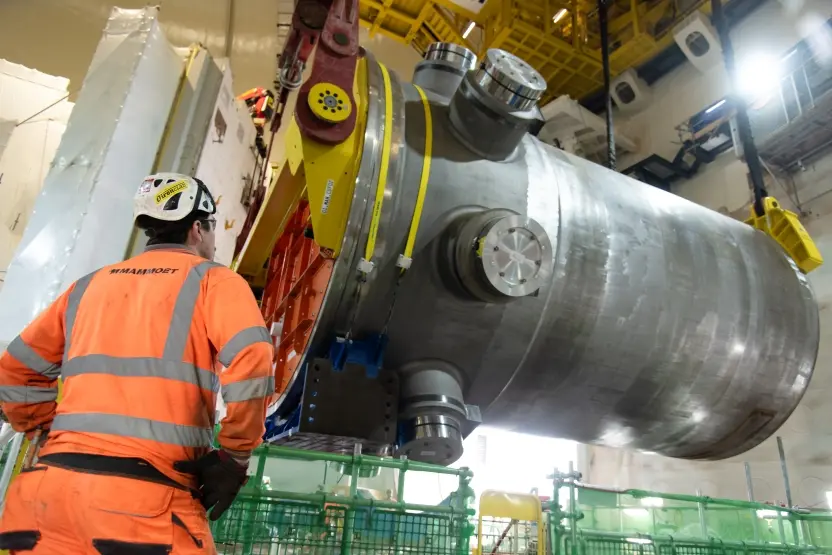
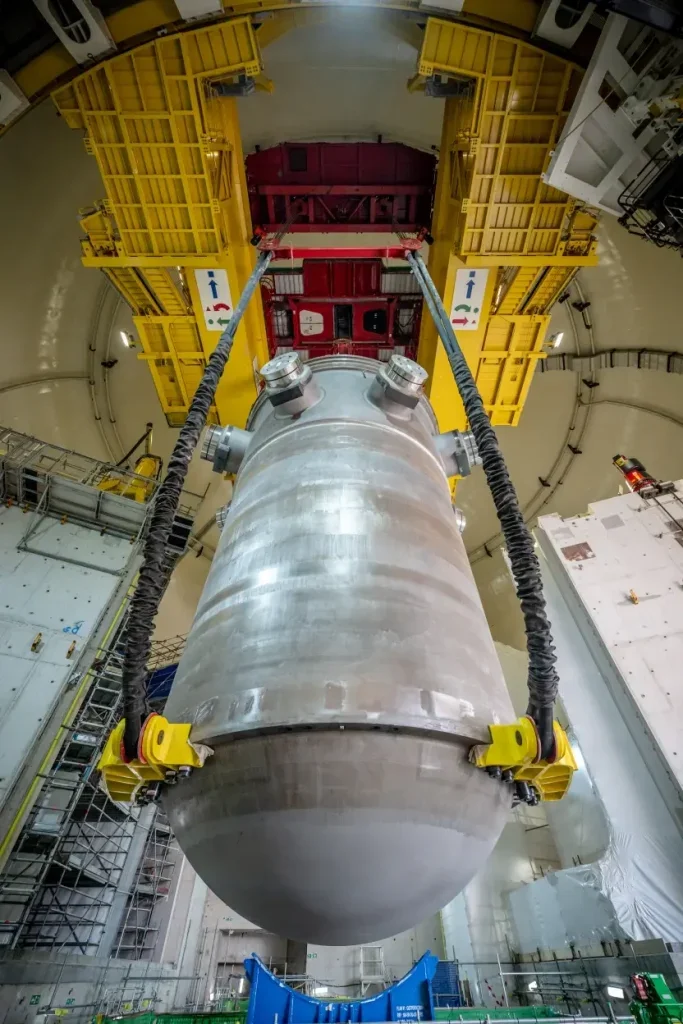
After being lifted, the RPV was inserted through a 19.5-metre-high equipment hatch for its precision installation inside the reactor building. Once inside the reactor building, the 13-metre-long RPV was lifted and rotated into a vertical position by the large internal “polar” crane and lowered carefully onto a support ring with just 40mm clearance on either side. The installation process took two days and was completed less than a year after the steel dome was lifted into place to close the second reactor building.
Unit 2 is being built 20-30% more quickly than unit 1, thanks to innovation and experience of building an identical design with the same teams. The unit 2 reactor building is further ahead than at the same stage for unit 1, with more equipment installed, as well as more structural steel work and the outer containment layer already in place. Three large heat exchangers have already been installed in unit 2, compared with none at the same point in unit 1. EDF Energy noted that these advantages and innovations will benefit Sizewell C from the start.
The RPV for unit 2 was manufactured at Framatome’s Saint-Marcel plant in Chalon-sur-Saône and was delivered to the Hinkley Point C site in January. The unit 1 RPV was completed at Framatome’s Le Creusot facility in Burgundy and was delivered to the site in February 2023. It was maintained and storage until its installation in December 2024.
EDF Energy noted that unit 2 of the plant is being built 20-30% more quickly than unit 1, thanks to innovation and experience of building an identical design with the same teams. “The unit 2 reactor building is further ahead than at the same stage for unit 1, with more equipment installed, as well as more structural steel work and the outer containment layer already in place,” the company said. “These advantages and innovations will benefit Sizewell C from the start.”
Simon Parsons, Hinkley Point C’s Delivery Director noted: “This marks a tremendous achievement by the entire team and one that has taken months of planning and close coordination between the 10 main contractors involved. We’ve also seen strong innovation to achieve not just a ‘cut and paste’ from the first reactor’s installation, but using our experience to save time, money and disruption to the site. Importantly, we are also applying those lessons to put unit 2 well ahead of the first unit’s position at the equivalent stage, with more materials in place and more work achieved.”
The planned Sizewell C plant on the Suffolk coast in East Anglia will have two EPR reactors of similar design and is expected to be built faster and at less cost based on experience at Hinkley Point. Sizewell C’s baseline construction cost is estimated to be 22% less than the lowest current estimate for Hinkley Point C. A final investment decision for Sizewell C was taken in July 2025 with construction expected to be completed by 2039.


