
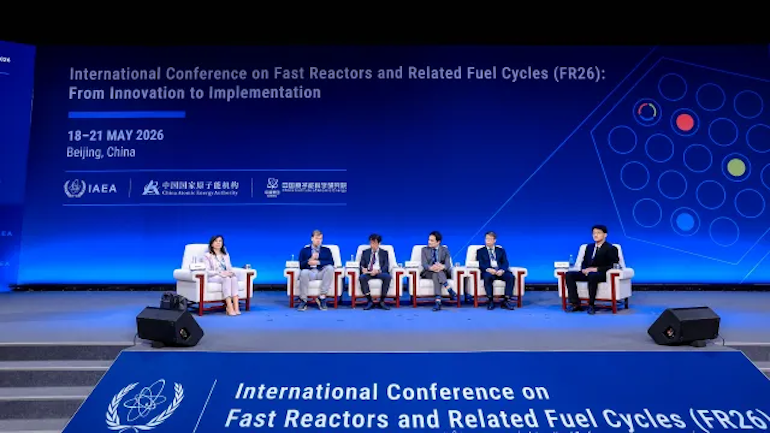
More than 550 experts from 42 countries attended the IAEA International Conference on Fast Reactors and Related Fuel Cycles (FR26) in Beijing hosted by the China Institute of Atomic Energy (CIAE), From Innovation to Implementation. FR26 was the fifth in a series that began in Kyoto in 2009 with subsequent meetings in Paris (2013), Yekaterinburg (2017), and in Vienna (2022). The last Conference, FR22, was attended by almost 473 participants from 30 countries.
“Fast reactor systems are a compelling option,” IAEA Director General Rafael Mariano Grossi said in his opening remarks to the conference. “They have the ability to optimize uranium resources, extracting as much as 70 times more energy than existing thermal reactors. And when operated within a fully closed fuel cycle, they can significantly reduce mining and high-level radioactive waste, important in terms of sustainability.”
Several countries are making significant progress on fast reactors. Russia is leading the field with one experimental and sodium-cooled two fast reactors in commercial operation and is building the lead-cooled BREST-OD-300, designed to demonstrate a fully integrated closed fuel cycle at a single site, with plans for larger sodium-cooled reactors.
China’s experimental fast reactor has operated since 2011, and its CFR-600 came online in 2023. In April, India’s Prototype Fast Breeder Reactor reached criticality. In the US, construction began recently on TerraPower’s Natrium plant, the first Gen IV reactor to receive a construction licence from the US Nuclear Regulatory Commission. Overall, the world has now accumulated more than 500 reactor-years of fast reactor operating experience.
“The capability is no longer hypothetical. The question before us is whether we can scale it safely, economically, and at the speed the century now demands,” said Mikhail Chudakov, IAEA Deputy Director General and Head of the Department of Nuclear Energy.
“Fast reactors and closed fuel cycles are increasingly viewed as essential to the long‑term sustainability, security, and responsible use of nuclear energy,” Evgeny Adamov, Conference Honorary Chair, said in a video presentation.
The conference was organised across nine technical tracks with 47 sessions, 219 oral presentations and two panel discussions. National presentations reflected an unusual degree of convergence.
China outlined a long-term strategy linking fast reactors and a closed fuel cycle to carbon neutrality and energy security, supported by strong domestic R&D and progression toward commercial systems. Japan described its pathway toward a sodium-cooled fast reactor demonstration and a fuel cycle technology selection by 2026.
France presented an integrated approach combining nuclear revival, renewables expansion, industrial strengthening and a closed fuel cycle as pillars of European energy security. The Republic of Korea reported steady progress on its sodium-cooled fast reactor and marine-focused molten salt concepts.
Russia emphasised the need for a full transition to fast reactors with inherent safety and onsite recycling as demonstrated by the BREST-OD-300 project. The European Commission’s Joint Research Centre highlighted coordinated research supporting Gen IV and advanced modular reactor deployment.
Hongyi Yang, Director General of the China Institute of Atomic Energy and co-chair of the conference, told the conference: “We fully recognize that fast reactor-based closed fuel cycles are essential to guarantee the sustainable development of nuclear energy. As the nuclear energy industry flourishes, integrated fast reactors have stepped into a new development stage, steadily moving from innovation to implementation.”
Two panel discussions looked at policy. The first panel with representatives from four countries, examined how fuel cycle facilities should be organised (co-located, centralised or otherwise) and concluded that the answer is not purely technical. It also depends on each country’s infrastructure, regulatory frameworks, safeguards arrangements, transport logistics and societal context. There is no single optimal solution for all.
The second panel, with representatives from eight countries pursuing fast reactors, examined how technology transfer and international cooperation can accelerate deployment through technology transfer without compromising safety, security or non-proliferation. The panel also discussed the challenges for the export of fast reactors and related technologies.
Advanced reactors and fuel cycles must be designed with safety, security and safeguards in mind from the very beginning, the conference emphasized. FR26 also underscored the importance of early career scientists and engineers, who will build and operate this emerging technology. Five winners of the Young Generation Paper Recognition received funded travel to Beijing to present work on fast reactor systems, advanced fuels and fuel cycle technologies.
The IAEA has supported fast reactor systems development for decades. Its Technical Working Group on Fast Reactors is in its 59th year; the Technical Working Group on Nuclear Fuel Cycle Options will mark its 25th anniversary in 2027. The International Project on Innovative Nuclear Reactors and Fuel Cycles (INPRO) coordinates work across member states on both technology and the strategic options that surround it.
Closing the conference, Chudakov set out the next steps for the community: clearer roadmaps, stronger and more transparent validation and modelling infrastructure, integrated safety, safeguards and generated waste outcomes by design, and continued international collaboration that reduces duplication and accelerates learning. The work, he said, is to turn the promise of fast reactors and closed fuel cycles “into practical, safe, secure, and economically viable systems.”


