
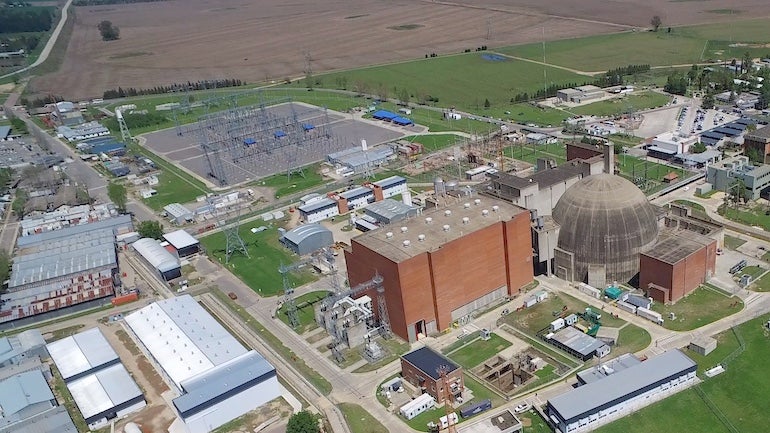
The Argentinian Nuclear Regulatory Authority (ARN – Autoridad Regulatoria Nuclear) has granted Nucleoeléctrica-SA (NA-SA) a new operating licence for the Atucha II NPP until 26 May 2036. The licence will allow the state generating company to operate the reactor for ten more years. This is the fourth licence extension for Atucha II.
Argentina has three operating NPPs, all pressurised heavy water reactors (PHWRs) – Embalse in Córdoba province, a 683 MWe Candu-6 reactor, operational since 1983, and the Atucha Nuclear Complex near the town of Lima in Buenos Aires province. The 362 MWe Atucha I began operation in 1974 and the 745 MWe Atucha II in 2014. Together they produce 10% of Argentina’s electricity.
Atucha II initially received a two-year operating licence and a second five-year licence in 2016. The last extension was approved by the ARN in February 2024 and expired on 26 May 2026. The new 10-year licence follows recent approval from ARN allowing the plant to operate at full capacity after seven years operating at a reduced capacity due to heavy water pump issues. Atucha I is currently shut down for major refurbishment work to enable life extension.
The long-term restriction to reduced power at Atucha II was primarily caused by a mechanical malfunction in one of the main heavy water circulation pumps within the reactor’s primary cooling circuit. Atucha II utilises heavily pressurised heavy water both as a coolant and a neutron moderator. One of the primary cooling loop pumps suffered an internal failure, restricting the volumetric flow rate of the coolant.
Under tight regulatory oversight by the ARN, engineers designed custom tooling to isolate, repair, and recalibrate the massive pump mechanics. Resolving this bottleneck restored the baseline hydraulic flow rate required to handle the thermal energy of a 100% fission load safely.
Before full power could be cleared, engineers also had to fix a critical internal structural failure that occurred deep inside the Reactor Pressure Vessel (RPV) after one of the internal structural supports inside the RPV broke free and detached. This detached metal component risked migrating into critical areas, blocking cooling channels, or physically damaging fuel elements during high-power fluid circulation.
Because the inside of the reactor vessel is a highly radioactive environment, human entry was impossible. Nucleoeléctrica’s engineering teams constructed a 1:1 full-scale physical mock-up of the impacted reactor section using an old decontamination chamber from an 18-year-old Atucha I repair archive. Teams used the mock-up to build, test, and practice precision cutting, grasping, and welding manoeuvres using specialised remotely operated robotic tools.
Once procedures were validated, the team deployed these custom tools into the real RPV, safely fragmenting and extracting the detached support element without needing to dismantle the upper core structures. However, ARN did not allow an immediate jump to 100% capacity. The return to full power followed a strict staged thermodynamic protocol, making possible the 10-year licence extension.
Nucleoeléctrica President Juan Martín Campos, said: “The renewal of this licence represents a recognition of the technical and operational capabilities developed by Nucleoeléctrica to guarantee a safe, reliable operation aligned with the highest regulatory standards … this new licensing period allows us to further consolidate the strategic role of Atucha II within the Argentine energy system and to project the development of the national nuclear sector in a context of growing global energy demand.”


