
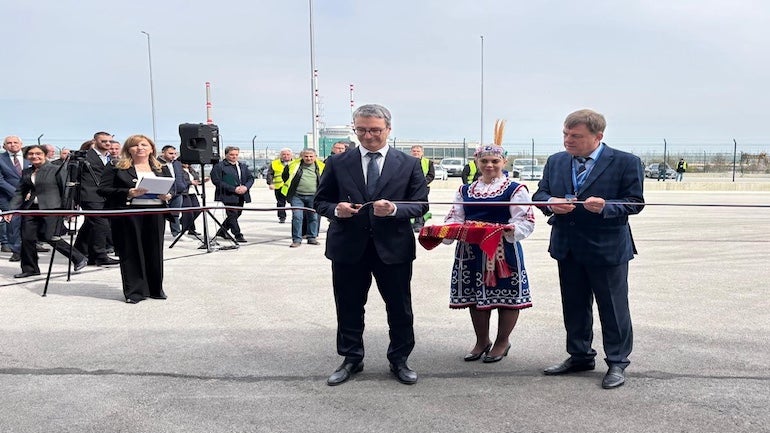
Bulgaria’s Acting Energy Minister Traicho Traikov has inaugurated the National Repository for Radioactive Waste (NKhRAO – Natsionalnovo Khranilishe za Radioaktivni Otpadtsi (НХРАО) following 15 years of construction work, the Ministry of Energy announced.
The repository, located at the Radyana site area close to the Kozloduy NPP, will store low- and intermediate-level radioactive waste generated in Bulgaria from industry, medicine and domestic use. It will not accept foreign radioactive material or used nuclear fuel and is expected to be filled over the next 60 years, after which it will be closed. It will be monitored throughout its lifetime and for the next 300 years.
Dilyan Petrov, Executive Director of the State Enterprise for Radioactive Waste (DPRAO – Drzhavnovo RadioAktivni Otpadtsi) said the site will store mainly technological materials such as contaminated clothing and tools, which account for around 90% of waste generated from nuclear power production. It will also take waste from decommissioning of the first four units of the Kozloduy NPP and from the operation of existing two units.
The facility consists of 66 disposal cells arranged across three platforms, with the first stage containing 22 cells currently operational in which 6336 containers can be stored. Each cell is made of reinforced concrete and can hold 288 reinforced concrete containers. A movable roof structure protects the cells from external conditions during filling.
Traikov said the project places Bulgaria among countries with advanced nuclear energy infrastructure, completing a significant part of the national nuclear safety cycle. “The full cycle of capabilities and equipment available in these countries encompasses a wide range of facilities and activities, and in this way we are effectively closing the cycle of safe operation and environmental protection,” he noted.
The facility includes two movable steel covers each weighing about 650 tonnes and a remotely controlled container arrangement system, that uses 30-tonne bridge cranes. “Various methods have also been introduced to reduce the volume of waste to effectively use the capacity of the facility: by plasma combustion, super pressing, decontamination of hard waste and precipitation and evaporation of liquid,” said Traikov. “These involve modern high-tech solutions and engineering experience, which can be exported as a service for the construction of future storage facilities in other countries.”
The repository was primarily funded by a grant of approximately €76m ($89m) from the Kozloduy International Decommissioning Support Fund (KIDSF) administered by the European Bank for Reconstruction and Development (EBRD) on behalf of the European Commission and other international contributors. The project also received national co-financing totalling approximately BGN34m ($20m) from the Bulgarian government.


