
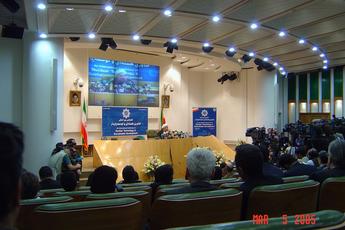
The International Conference on Nuclear Technology and Sustainable Development was held just a few days after a board of governors meeting at the International Atomic Energy Agency (IAEA) in Vienna where the USA had once again accused Iran of pursuing a clandestine nuclear weapons programme and of violating its IAEA safeguards agreements, insisting that the case should be referred to the UN Security Council.

Hassan Rohani addresses delegates in Teheran
The board heard a report from Pierre Goldschmidt, head of IAEA safeguards, on developments since November 2004 which included inspections at facilities in Tehran, Natanz, and Esfahan, and complementary access at three other locations. He said Iran had “facilitated in a timely manner agency access to nuclear material and facilities under its safeguards agreement and Additional Protocol.”
He added that the IAEA was expecting progress on the origin of low-enriched and high-enriched uranium particle contamination of old centrifuge components following collection of environmental samples at locations outside Iran, where components had been stored before shipment. In response to an IAEA request for all relevant documentation on equipment supplies, Iran had shown the agency a document detailing an offer in 1987 by a foreign intermediary to supply a disassembled sample machine; drawings, specifications and calculations for a “complete plant”; and materials for 2000 centrifuge machines. Iran said only some of these items were delivered and all of them had been declared to the IAEA.
Goldschmidt said the agency had continued implementing the measures of the Additional Protocol under which complementary access at the Uranium Conversion Facility (UCF) site on 15 December 2004 had revealed underground excavation activities “which Iran had failed to report in a timely manner.” However, two days before the visit Iran had submitted an updated design information questionnaire providing preliminary information on the tunnel which was intended for safe storage of nuclear material.
The IAEA had not visted the site of Iran’s new IR-40 research reactor which was being built despite an earlier Board of Governors request for Iran to reconsider the project “as a further confidence-building measure.”
The agency had asked for clarification concerning activities at a site at Lavisan, but Iran had said the site “was not involved in activities declarable under the NPT safeguards.” Limited access had been granted to another site at Parchin where the agency had found “no relevant dual-use equipment or materials in the location visited.”
Goldschmidt said the agency had continued to verify Iran’s voluntary suspension of enrichment related and reprocessing activities, and had established an inventory of all uranium hexafluoride (UF6), essential centrifuge components, key raw materials and equipment, and the assembled centrifuge rotors at declared workshops. Monitoring had continued at Natanz, including the Pilot Fuel Enrichment Plant and the Fuel Enrichment Plant. The 20 sets of centrifuge components initially intended for research and development purposes remained under surveillance. The agency had also monitored centrifuge component production capabilities at workshops, selected randomly.
The agency had continued verification of voluntary suspension of conversion activities at UCF where Iran had processed 37t of uranium ore concentrate (yellowcake) as feed material for facility testing. All the yellowcake had been converted into intermediate products and the agency had installed seals to verify production had stopped. The material produced is now under agency seal and monitored with cameras. Further verification will take place in April following clean-out operations.
NO PERMANENT SUSPENSION
At the conference – which was attended by nuclear experts from 11 foreign countries as well as 12 international organisations – all the Iranian speakers clearly saw mastery of the fuel cycle as a matter of national pride and were unanimous that any suspension of activities could only be temporary.
Iran’s chief nuclear negotiator Hassan Rohani said Iran would continue with a full civilian nuclear power programme, including enrichment, but would discuss any additional safeguards and transparency measures necessary to reassure other states about the peaceful character of the programme. Rohani also made clear that any requests for a permanent end to Iran’s fuel cycle activities would be unacceptable. Iran agreed last year to suspend making nuclear fuel for a few months for the duration of talks with Britain, France and Germany in an effort to head off possible punitive action by the USA.
Rohani told a press conference after the first session that Iran had presented a formula to senior European officials offering real guarantees while still allowing Iran to develop its technology. “If Europe refuses to accept this formula,” he said, “it will face problems.” Iran would make public the details which would prove its willingness to cooperate and would show the Europeans as obstructive. “The ball is in the Europeans’ court right now,” he said. “Economic incentives including purchasing Airbus [aircraft] and joining the World Trade Organisation will not compensate for relinquishing enrichment.”
The head of the Atomic Energy Organisation of Iran (AEOI), Gholamreza Aqazadeh, said independence, particularly in modern technology, was vital for sustained and long-term development. He stressed the importance of energy diversity, including nuclear power and “the production and supply of nuclear fuel and construction of heavy water reactors for production of electricity and medical isotopes.”
Foreign minister Kamal Kharrazi said access to the nuclear fuel cycle “must not face any impediment,” provided it is not aimed at acquiring weapons and is subject to IAEA supervision. Mohammad Sa’idi, the deputy director for planning and international affairs of the AEOI, noted that Iran had launched nuclear research reactors, conducted research in plasma physics and radioisotope production as well as in nuclear agriculture and nuclear engineering, and was proud of its achievements in heavy water production.
A WARNING TO EUROPE
The conference saw an open and candid exchange of views with significant differences of opinion over the international implications of Iran’s nuclear programme resulting in real dialogue.
Alaeddin Boroujerdi, head of the national security and foreign policy committee of the Iranian parliament, told the conference that Parliament would not approve the additional protocol to the NPT if the Europeans insist on permanent suspension of uranium enrichment-related activities. Iran's top nuclear negotiator, Hossein Mousavian, said European demands for a permanent freeze went against accords already signed with Iran and killed the process of negotiation,
One of the most controversial presentations came from Philippe Errera, Deputy Director of the “Centre d’Analyse et de Prévision” (planning staff) in the French Ministry of Foreign Affairs who offered a European perspective, although he said he was speaking in a personal capacity. “We consider that the only objective guarantee of the exclusively peaceful nature of Iran’s nuclear programme is the effective cessation of all activities leading to the production of nuclear materials,” he said. The agreement reached last year “did not define precisely enough the scope of suspension,” he added, accusing Iran of violating the spirit, if not the letter of the agreement. “Iran can be a key regional and international player, as well as a partner for the West. But only if it chooses policies that are compatible with such an orientation.”
Nasser Saghafi-Ameri, a senior fellow at Iran’s Centre for Strategic Research (CSR) said the fundamental issue was not about legal niceties but trust and confidence. He said the Europeans and the Americans “have engaged in what could be seen as a delicately crafted ‘good cop, bad cop’ routine.” They assume there is a military character to Iran’s programme which threatens the stability in the entire Middle East, and imply that if Iran fails to reach agreement on the nuclear issue, the Europeans may not be able to curb US intervention
However, he insisted that for Iran it makes perfect economic sense to produce nuclear fuel locally, instead of depending on a more expensive foreign source. Imports of 27t of Russian nuclear fuel import for Bushehr for a year would cost $50 million instead of $25 million for local production, he noted. “Nor is it prudent from the point of view of environmental safety to rely on long-distance shipments of the nuclear fuel and the return of spent fuel, when the latter can be more safely deposited in Iran’s vast deserts.”
Addressing the final session of the conference, the chairman of the State Expediency Council, Akbar Hashemi Rafsanjani, expressed dissatisfaction with the European talks.
“Confidence-building is an accepted principle,” he said, but noted that closing centres working on nuclear activities for several months has hurt the workers’ living conditions.
Iranian public opinion is not happy with the halt of nuclear activities, he said.
He acknowledged Iran’s past secrecy about its nuclear affairs but pointed out that this was a direct result of sanctions. “Nobody sold us anything in the market,” he said. However, Iran had been “very transparent” since 2002. He repeated that Iran would never agree to permanently stop enrichment and said maintaining the voluntary freeze would depend on progress in the European talks “Definitely we can’t stop our nuclear programme and won’t stop it. You can’t take technology away from a country already possessing it.”
The conference was co-sponsorsed by the Ministry of Foreign Affairs, the Atomic Energy Organisation of Iran, and the Ministry of Science, Research and Technology, and was organised by the Centre for Strategic Research of Iran’s Expediency Council.
Related ArticlesYucca data scandal sees FBI probe



